
CERIC Resources for Librarians
This page is for subject and liaison librarians, information-literacy instructors, and anyone maintaining a research guide on reading scholarly articles. Everything here is free to reuse. The cheat sheet is licensed CC BY 4.0, so you can upload it to your guide, print it for workshops, and translate it, with attribution.
The handout: a one-page reading checklist
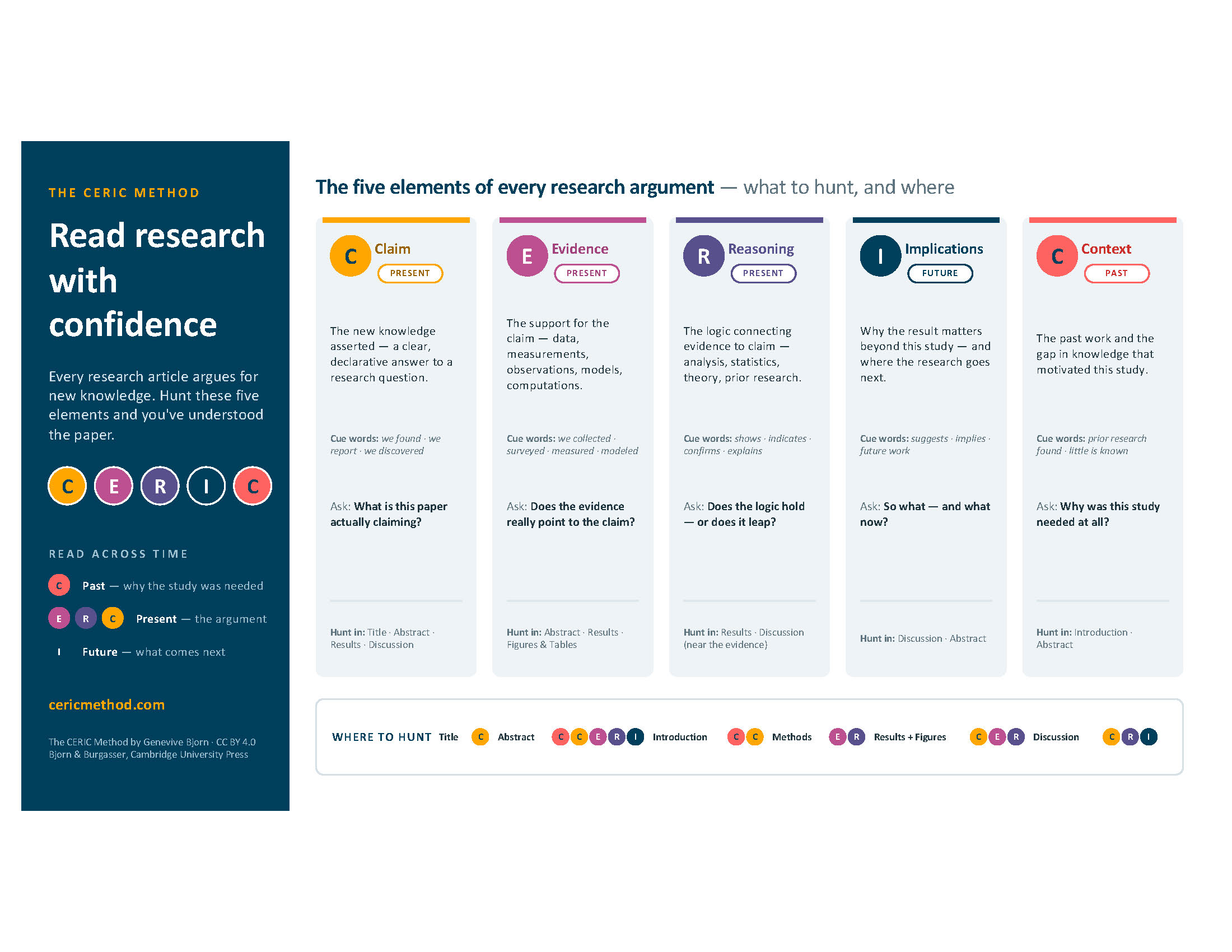
The CERIC cheat sheet condenses a method for critically reading scientific research articles onto one page: the five elements every article is built from (Claim, Evidence, Reasoning, Implications, Context), where each one usually appears in a typical article, and the question a reader should ask. It is discipline-neutral and works for undergraduates meeting primary literature for the first time as well as graduate students and early-career researchers.
- Cheat sheet, print PDF (US Letter, color)
- Cheat sheet, print PDF (A4, color)
- Cheat sheet, print PDF (US Letter, grayscale) and (A4, grayscale) for black-and-white printing
- Cheat sheet, image (JPG) (embed as an image)
- Cheat sheet, 16:9 screen version (for slides and instruction sessions)
License and citation. CC BY 4.0. Please cite as: Bjorn, G. and Burgasser, A. J. (2026). The CERIC method cheat sheet. cericmethod.com. https://cericmethod.com/ceric-cheat-sheet/. For translations, add: “Translated and adapted from the original by [Name] under license CC BY 4.0.” Editable source files (PowerPoint) are available on request through the contact page.
Ready-made LibGuides box
If it saves you time, here is a box you can paste into a LibGuides “Rich Text / HTML” content item. It contains the handout image, a short description, the download link, and links to three student guides. Replace the image link with your own upload if you prefer to host the file locally.
<div class="ceric-box">
<a href="https://cericmethod.com/wp-content/uploads/2026/11/CERIC_Cheat_Sheet_Print_Letter.pdf">
<img src="https://cericmethod.com/wp-content/uploads/2026/07/CERIC_Cheat_Sheet_Screen_16x9_preview.jpg"
alt="CERIC Method cheat sheet: Claim, Evidence, Reasoning, Implications, Context"
style="max-width:100%;height:auto;border:1px solid #ddd;">
</a>
<p><strong>CERIC: a one-page checklist for reading any scientific article.</strong>
Every research article is built from five elements: the <em>Claim</em>, the <em>Evidence</em> for it,
the <em>Reasoning</em> that connects them, the <em>Implications</em>, and the <em>Context</em> that
motivated the study. This handout shows where to find each one and what question to ask.
Read for the Claim first, not the introduction.</p>
<ul>
<li><a href="https://cericmethod.com/wp-content/uploads/2026/11/CERIC_Cheat_Sheet_Print_Letter.pdf">Download the cheat sheet (PDF)</a></li>
<li><a href="https://cericmethod.com/how-to-read-a-scientific-paper/">How to read a scientific paper: a step-by-step method</a></li>
<li><a href="https://cericmethod.com/how-to-evaluate-evidence-in-a-research-article/">How to evaluate the evidence in a research article</a></li>
<li><a href="https://cericmethod.com/how-to-run-a-journal-club/">How to run a journal club that teaches critical reading</a></li>
</ul>
<p style="font-size:90%;">From <em>How to Critically Read the Scientific Research Literature</em>
(Bjorn & Burgasser, Cambridge University Press, 2026). Cheat sheet licensed CC BY 4.0.</p>
</div>Short description for your guide
If you would rather write your own box, this description is in the register most guides use and can be pasted as is:
The CERIC Method is a five-question hunt-and-seek approach to reading research articles critically: identify the Claim, the Evidence for it, the Reasoning that connects them, the Implications for future research, and the Context that motivated the study. Developed by education researcher Genevive Bjorn and astrophysicist Adam Burgasser and published by Cambridge University Press (2026), it is discipline-neutral and designed for students reading empirical primary literature for the first time. A free one-page cheat sheet (CC BY 4.0) and short guides on reading a paper, evaluating evidence, and running a journal club are available at cericmethod.com.
Evidence base
The method has a peer-reviewed evaluation. In an interdisciplinary graduate course, explicit CERIC instruction combined with social collaborative annotation improved students’ critical reading of primary literature over four weeks. Bjorn, G. (2024). The CERIC method plus social collaborative annotation improves critical reading of the primary literature in an interdisciplinary graduate course. Frontiers in Education, 9:1257747. https://doi.org/10.3389/feduc.2024.1257747 (open access). The full method is described in Bjorn, G. and Burgasser, A. J. (2026). How to Critically Read the Scientific Research Literature: Introducing the CERIC Method. Cambridge University Press. ISBN 9781009631273.
Three guides to link for students
- How to Read a Scientific Paper: A Step-by-Step Method. Why reading start to finish fails, the five questions in the order experts use, and the five-sentence review that tells you when you are done.
- How to Evaluate the Evidence in a Research Article. Three questions for judging evidence without being a methods expert, a quick 1-3-1 test, and a four-level rating scale.
- How to Run a Journal Club That Actually Teaches Critical Reading. A sixty-minute agenda, rotating roles, and fixes for drift and dominance; includes an asynchronous version using social annotation tools.
For the faculty you support
Instructors can download a free teaching pack (per-article analysis template, discussion guide with twelve prompts by element, assignment rubric, and a quick-reference card), or see the For Educators page. The book is designed for adoption in research methods, scientific writing, and information literacy courses; examination copies are available from Cambridge University Press. We also run live workshops for programs, labs, and library instruction teams, and are glad to co-teach a session with a library.
If you add CERIC to a guide, we would love to know so we can list your library as an example for others; the contact page reaches us directly.